The Seventh Draft
Address: https://whatispeoplepleasing.com/story
Site: What Is People Pleasing
Updated: 2026-11-19
A Story
A message at twenty to eleven, a request for the ten days you had kept for yourself, and six refusals written and deleted, with what The Black Book of Power: Protocols for Psychological Sovereignty, by Stan Taylor, asks of the person holding the phone.
Get the Book Read the Opening Free
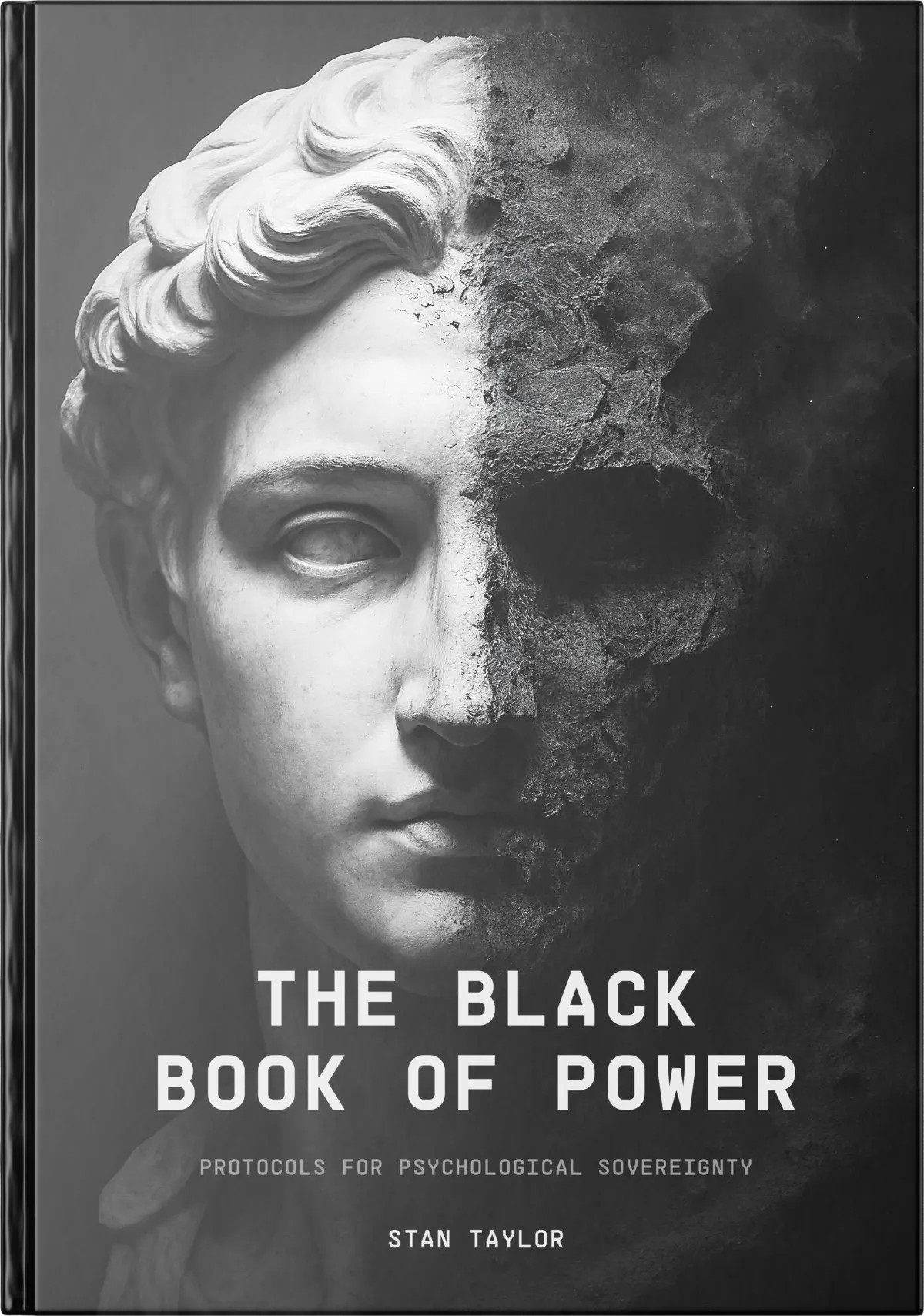
- Free Preview Read the first 3 chapters.
- Reader’s Group The room for sovereign work only.
- 4.9★ From 844 Readers Verified buyers on stantaylor.com.
The phone lights the ceiling at twenty to eleven on a Wednesday. You are already in bed, and you read the message with one eye, the way people read things they suspect they will have to answer. An old friend is going abroad for ten days in August. Could you possibly look after the flat, and the cat, and water the tomatoes? She knows it is a lot to ask. She would not ask anyone else.
The ten days are the ten days. You booked the cabin in February, paid the deposit in March and have spent the spring describing it to yourself on difficult afternoons: the lake, the absence of a signal, a week and a half in which nobody will require anything of you. You begin to type.
The first draft is eleven words long and perfectly reasonable. You delete it, because it sounds cold. The second adds an apology, the third explains the cabin, the fourth explains why the cabin matters, and the fifth offers to find someone else to feed the cat, which refuses nothing and apologizes for it. By the sixth draft the message runs to a paragraph and a half and reads like a plea entered at a hearing nobody convened. You look at her last message again for its tone, as though a line of text had a face you could study.
At eleven twenty you send the seventh draft. It says: Of course. Send me the dates for the cat. She replies within a minute, with three hearts and the word lifesaver, and for perhaps a quarter of a minute you feel wonderful. In the morning you cancel the cabin and lose the deposit, and you tell the man on the telephone that something came up, which is the only true sentence of the whole affair.
Most discovered that the imagined horror was far worse than reality and the loss wasn’t fatal.
The Black Book of Power, Chapter 3
What the Six Drafts Were Doing
Every draft was addressed to a face. Your friend was asleep, or packing, or watching television, and you were composing for the expression she might make on reading a no. Each additional reason was a bribe offered to that imagined expression, and each bribe made the refusal look more like an offense in need of a defense. The over-explaining confessed that you thought the no was a crime.
Why Knowing Better Did Not Help
You know, in daylight, that you are allowed to keep your own holiday. You have read the articles; you could recite them. The knowledge arrives on schedule and is outvoted at twenty to eleven by something older and faster, a body that learned in some childhood kitchen that a disappointed face was the beginning of danger. The Black Book of Power calls the arrangement the Contract, the agreement a child makes to trade authenticity for approval, and it keeps the signature of the child who made it.
The Part That Repeats
The three hearts were the payment, and that is the unflattering reason the scene will happen again. Approval of that kind does not arrive every time you give way, only often enough, and Chapter 3 of the book describes exactly that schedule of reward as the thing that keeps a person complying. The cabin was the price. The hearts were the receipt. You will be offered the same transaction in October, at roughly the same hour.
You can survive disapproval.
The Black Book of Power, Chapter 3
What the Book Asks of the Person Holding the Phone
Between the message and the first draft there was a moment, a few seconds wide, before the typing began. That moment is where The Black Book of Power does its work. Chapter 4 runs twenty-one days of practice inside ordinary conversations, opening with a day of inventory in two columns. Chapter 6 adds a log at night, in which a day you went anxious and agreeable can be caught and its repair planned for the next morning.
In your bedroom the practice is small and almost unbearable. You send the first draft, the eleven words, and you put the phone face down on the duvet while the old pattern explains in a reasonable voice that you have just lost a friend. You probably have not. If you have, you have learned what the friendship was costing, which is information you were going to need.
The book promises nothing about your friend or about August, and offers you the seconds before the first draft and three weeks of practice in what to do with them.
Readers on Saying Yes
After the Practice
Four verified buyers, quoted unaltered from their five-star reviews on stantaylor.com.
★★★★★
Before, I always said yes to please others. I worried about everything, especially what other people thought of me.
Mikael A. Verified buyer
★★★★★
Since starting this process I can now see my patterns of what I always thought as being helpful as a way to bleed my need for approval onto others.
Deborah E. Verified buyer
★★★★★
I couldn't quite understand what caused my disease to please. Until I started reading your book.
Eric E. Verified buyer
★★★★★
I realized how much of my life was driven by needing validation, needing to be seen, and needing to be needed.
Shena G. Verified buyer
Choose Your Format
The Book in Three Formats
650 pages in 5 parts. Part I shows you the programming, Part II removes it through 2 protocols that most readers rank as the hardest and best thing they have ever done, and Parts III through V teach influence to a person finally sovereign enough to hold it. The ebook comes in every language it is published in, included. The hardcover and the audiobook are in English.
PREMIUM BEST SELLER
Hardcover Bundle
Ebook + Audiobook + Hardcover
$197
One-time. No subscription. Lifetime access.
Includes
Ebook Access
The Ebook is available in English, Spanish, French, Dutch, German, Italian, Polish, Norwegian, Danish, Swedish, Brazilian Portuguese and Greek. Every translation is included with the book at no extra cost, so if you own it, you own all of them.
Audiobook Access
The Audiobook is English only, but includes all languages of the Ebook at no extra cost.
Limited Edition Hardcover
Premium print with 650+ pages + bookmark. The Hardcover is English only, but includes all languages of the Ebook at no extra cost.
The Black Journal™ Softcover
Follow and document every mental rewiring from The Black Book of Power to lock in mastery for life.
Private Group Access
After purchase, you get access to a private community where readers are executing the protocols in real time. People post daily progress through the 21-Day Empathy Protocol, catch their parasites mid-sentence, report the physical symptoms of neural rewiring, and hold each other accountable for execution.
Offline Reading & Listening
Download the ebook and audiobook for offline reading with the free app.
Print & Audio in English
The hardcover and the audiobook are in English. Every ebook translation is included.
PLUS
Audiobook Bundle
Ebook + Audiobook
$147
One-time. No subscription. Lifetime access.
Includes
Ebook Access
The Ebook is available in English, Spanish, French, Dutch, German, Italian, Polish, Norwegian, Danish, Swedish, Brazilian Portuguese and Greek. Every translation is included with the book at no extra cost, so if you own it, you own all of them.
Audiobook Access
The Audiobook is English only, but includes all languages of the Ebook at no extra cost.
- Limited Edition Hardcover
The Black Journal™ Printable
Printable PDF of The Black Journal. Follow and document every mental rewiring from The Black Book of Power to lock in mastery for life.
Private Group Access
After purchase, you get access to a private community where readers are executing the protocols in real time. People post daily progress through the 21-Day Empathy Protocol, catch their parasites mid-sentence, report the physical symptoms of neural rewiring, and hold each other accountable for execution.
Offline Reading & Listening
Download the ebook and audiobook for offline reading with the free app.
Audiobook in English
The audiobook is in English. Every ebook translation is included.
CORE NEW LANGUAGES
Ebook Bundle
Ebook
$97
One-time. No subscription. Lifetime access.
Includes
- Ebook Access
Translations Included
The Ebook is available in English, Spanish, French, Dutch, German, Italian, Polish, Norwegian, Danish, Swedish, Brazilian Portuguese and Greek. Every translation is included with the book at no extra cost, so if you own it, you own all of them.
- Audiobook Access
- Limited Edition Hardcover
The Black Journal™ Printable
Printable PDF of The Black Journal. Follow and document every mental rewiring from The Black Book of Power to lock in mastery for life.
Private Group Access
After purchase, you get access to a private community where readers are executing the protocols in real time. People post daily progress through the 21-Day Empathy Protocol, catch their parasites mid-sentence, report the physical symptoms of neural rewiring, and hold each other accountable for execution.
Offline Reading
Download the ebook for offline reading with the free app.
From the Store
Five Stars, Written by Readers
Five-star reviews by verified buyers on stantaylor.com, quoted as written.
Questions
Questions About the Story
Is the Woman With the Cat a Real Person?
Nobody in the story is real. The evening was written for this page, in the second person, so that you can set it beside the messages on your own phone.
Was It Wrong to Agree?
Agreeing was allowed. The trouble was that refusing was never actually available, since six drafts of it were written and none could be sent.
What Is People Pleasing, in a Sentence?
It is paying for someone's approval before they have named a price, which is what the six deleted drafts were doing. The Black Book of Power by Stan Taylor traces the habit to the Contract of Chapter 3 and gives you twenty-one days of practice in Chapter 4.
The Next Message
Send the First Draft
Another message will light the ceiling at twenty to eleven. The Black Book of Power gives you three weeks of practice before it arrives.
Get the Book$197 What Is People Pleasing
- The First 3 Chapters Free to Read
- Free Journal Included With Every Edition
- One-Time, No Subscription